Darwin rental yields remain among Australia’s strongest in 2026. See rents, yields and suburb insights.
Darwin Rental Yield 2026: What Homeowners, Sellers and Investors Need to Know
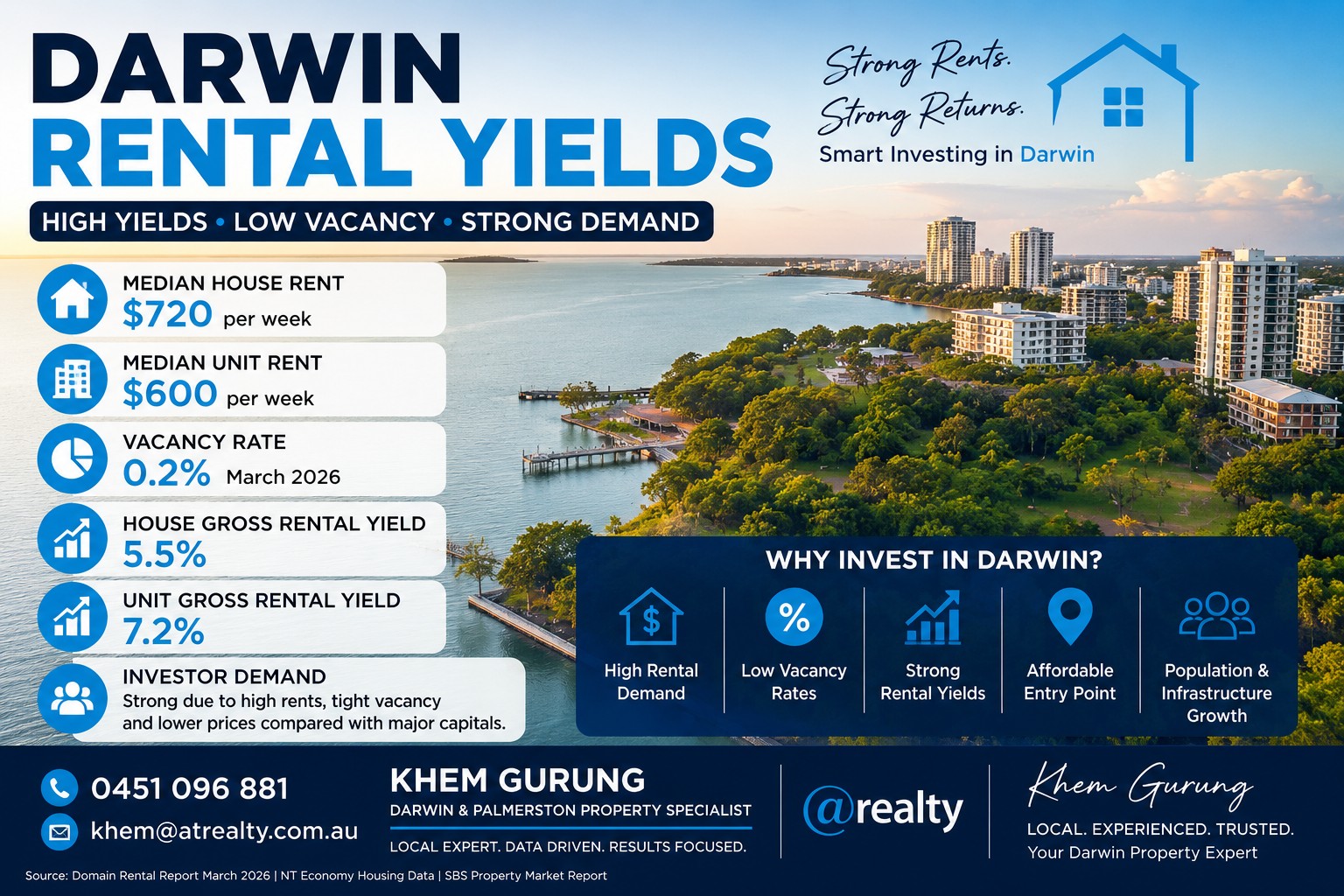
Darwin remains one of Australia’s strongest rental yield markets in 2026. Current data shows Darwin house rents around $720 per week, unit rents around $600 per week, and vacancy sitting extremely tight, with Domain reporting Darwin vacancy at 0.2% in March 2026.
For investors, Darwin’s gross rental yields are attractive compared with many larger capital cities. SBS reported Darwin units delivering around 7.2% gross rental yield, while houses were around 5.5%, supported by strong rents and relatively affordable property prices.
For homeowners thinking of selling, strong rental yield can increase buyer demand because investors are actively looking for income-producing properties in Darwin, Palmerston and nearby suburbs.
Why Darwin Rental Yield Matters in 2026
Rental yield is one of the biggest reasons investors are paying attention to Darwin.
In simple terms, rental yield shows how much rental income a property produces compared with its value. A strong yield can make a property more attractive to investors because it helps cover holding costs, loan repayments, insurance, council rates, body corporate fees and maintenance.
According to the NT Government’s housing data, Greater Darwin recorded median house prices of $670,000, median unit prices of $440,000, median weekly house rents of $711, and median weekly unit rents of $560 in the December quarter 2025.
Domain’s March 2026 Rental Report showed Darwin house rents increased to $720 per week, while unit rents remained at a record $600 per week.
This is why Darwin is not only a lifestyle market — it is also a cash-flow market.
Darwin Rental Yield Snapshot 2026
Median house rent: Approx. $720 per week
Source: Domain Rental Report March 2026Median unit rent: Approx. $600 per week
Source: Domain Rental Report March 2026Darwin vacancy rate: Around 0.2% in March 2026
Source: Domain Rental Report March 2026House gross rental yield: Around 5.5%
Source: SBS News Property Market ReportUnit gross rental yield: Around 7.2%
Source: SBS News Property Market ReportInvestor demand: Strong due to high rents, tight vacancy and lower property prices compared with major capital cities
Sources: NT Economy Housing Data and Domain Rental Report
Domain reported Darwin’s vacancy rate tightened to a record low of 0.2% in March 2026, showing extremely limited rental supply.
SBS also reported that Darwin’s gross rental yield sits around 6% overall, with units around 7.2% and houses around 5.5%.
What Is Rental Yield?
Rental yield measures the rental income a property generates compared with its value.
Simple formula:
Gross rental yield = annual rent ÷ property value × 100
Example:
If a Darwin unit rents for $600 per week, the yearly rent is:
$600 × 52 = $31,200 per year
If the unit is worth $440,000, the gross rental yield is:
$31,200 ÷ $440,000 × 100 = 7.09% gross yield
This is why units in Darwin often appeal strongly to investors.
Why Darwin Has Strong Rental Yields
Darwin’s rental yield strength comes from four main factors.
1. Low vacancy rate
A low vacancy rate means fewer rental properties are available. When supply is tight, tenants have fewer options, and rents can remain strong.
Domain reported Darwin vacancy at 0.2% in March 2026, one of the tightest rental conditions in the country.
2. Strong weekly rents
Darwin rents remain high compared with property values. This creates better yield compared with cities where property prices are very high but rents do not rise at the same pace.
3. Lower entry price compared with major capitals
Darwin is still more affordable than Sydney, Melbourne and Brisbane in many areas. That means investors can buy at a lower price point while still receiving strong weekly rent.
4. Investor demand is returning
SBS reported that investor activity in the Northern Territory has increased, with investors chasing strong rental returns and relatively affordable property prices.
Best Darwin Suburbs for Rental Yield in 2026
Rental yield changes depending on the suburb, property type, condition, body corporate fees, land size, tenant demand and maintenance risk.
Below is a suburb-focused guide for Darwin homeowners and investors.
Darwin CBD
Darwin CBD units can produce strong rental returns because of demand from workers, students, hospital staff, defence personnel, contractors and short-term lifestyle renters.
However, owners must carefully check:
Body corporate fees
Building age
Lift and pool maintenance
Vacancy risk
Short-stay restrictions
Insurance costs
High rent does not always mean high net return if body corporate fees are high.
Internal link suggestion:
Read more: Darwin Property Insights
Nightcliff
Nightcliff remains one of Darwin’s strongest lifestyle suburbs. It appeals to tenants who want coastal living, walking tracks, cafes, markets and access to the foreshore.
Nightcliff may not always produce the highest gross yield, but it can attract strong tenant demand and long-term owner-occupier appeal.
Internal link suggestion:
Read more: Nightcliff Property Market 2026
Rapid Creek
Rapid Creek is attractive because of its location near the beach, markets, schools and Charles Darwin University. Investors often like Rapid Creek because it can attract both tenants and future buyers.
Older units and townhouses may show strong yield, but owners should check maintenance, insurance and body corporate records.
Millner
Millner can appeal to investors because it sits close to Nightcliff, Rapid Creek, Coconut Grove and major roads. It can offer a more affordable entry point compared with premium coastal suburbs.
For sellers, highlighting rent potential and location convenience can help attract investors.
Coconut Grove
Coconut Grove can suit investors looking for central positioning between Darwin CBD, Nightcliff and the northern suburbs.
Internal link suggestion:
Read more: Coconut Grove Property Market Report
Nakara
Nakara benefits from proximity to Charles Darwin University, Casuarina Square, Royal Darwin Hospital and northern suburbs employment hubs.
This can create steady rental demand from students, healthcare workers, families and professionals.
Internal link suggestion:
Read more: Nakara Property Market Darwin 2026
Tiwi
Tiwi is popular because of its proximity to Royal Darwin Hospital, Casuarina, schools and the beachside suburbs.
Internal link suggestion:
Read more: Tiwi Darwin Property Market 2026
Marrara
Marrara can appeal to families and tenants wanting access to sporting facilities, schools, airport access and central Darwin convenience.
Rental demand can be strong for well-maintained homes with practical layouts, good parking and low-maintenance yards.
Karama
Karama can offer affordable entry compared with some inner Darwin suburbs. Investors often look at Karama for houses with stronger land component and family rental demand.
For sellers, presentation, repairs and pricing strategy matter because buyers will compare condition carefully.
Palmerston
Palmerston suburbs such as Zuccoli, Johnston, Bellamack, Durack and Gunn can attract families and investors looking for newer homes, lower maintenance and strong rental demand.
The NT Government reported Palmerston house rental yield around 5.1% in the December quarter 2025.
Internal link suggestion:
Read more: Darwin & Palmerston Property Market 2026
Houses vs Units: Which Has Better Rental Yield in Darwin?
Units often produce higher gross rental yields because they are cheaper to buy but can still achieve strong weekly rent.
SBS reported Darwin units at around 7.2% gross rental yield, while houses were around 5.5%.
However, houses can still be attractive because they may offer:
More land value
Family tenant demand
Future redevelopment potential
Lower body corporate risk
Stronger owner-occupier appeal
Units may offer:
Higher gross yield
Lower purchase price
Strong tenant affordability
Easier entry for investors
Better cash-flow potential
The best option depends on the investor’s goal: cash flow, capital growth, low maintenance, land value or long-term resale.
What Darwin Homeowners Should Know Before Selling to Investors
If you own a Darwin property and rental yields are strong, your home may appeal to investors as well as owner-occupiers.
Before going to market, homeowners should prepare the following:
1. Know the current rental estimate
Ask for a realistic rental appraisal before selling. Investors want to know what rent the property can achieve today, not what it rented for three years ago.
2. Prepare lease information
If the property is tenanted, have these ready:
Current rent
Lease start and end date
Bond amount
Tenant history
Rental ledger if available
Property manager details
3. Highlight investor-friendly features
Investors like:
Low maintenance
Strong rent
Good tenant demand
Secure parking
Air-conditioning
Location near employment, schools, hospitals or shops
Low vacancy risk
4. Fix small presentation issues
Minor repairs can improve buyer confidence. Investors do not want to inherit unnecessary problems.
5. Be transparent about costs
Investors will calculate net return, not just gross rent. Be ready to disclose:
Council rates
Body corporate fees
Insurance
Water costs
Maintenance history
Property management fees
6. Price correctly from day one
Overpricing can reduce investor interest. Investors are numbers-driven and will compare your property against other options quickly.
Step-by-Step Guide for Darwin Homeowners
Step 1: Get a current market appraisal
Start with a property value estimate based on recent sales, active listings and buyer demand.
Internal link suggestion:
Read more: How Much Is My House Worth in Darwin?
Step 2: Get a rental appraisal
This helps you understand how investors may view your property.
Step 3: Calculate gross yield
Use the formula:
Annual rent ÷ property value × 100
Step 4: Calculate likely net return
Subtract likely expenses such as rates, insurance, body corporate, repairs and management fees.
Step 5: Identify your buyer type
Your property may suit:
First-home buyers
Families
Investors
Interstate buyers
Defence workers
Downsizers
SMSF buyers
Step 6: Prepare documents
Get contracts, title, body corporate information, rental details and compliance information ready early.
Step 7: Choose the right selling strategy
A strong campaign should attract both emotional owner-occupiers and numbers-focused investors.
Step 8: Use professional marketing
Photos, floor plans, copywriting, video and suburb data can help position your property properly.
Step 9: Create competition
The best price often comes from competition, not just listing the property and waiting.
Step 10: Negotiate with data
Use rental yield, comparable sales, vacancy rates and buyer demand to support your price.
Is Darwin Good for Rental Yield in 2026?
Yes. Darwin is one of Australia’s strongest rental yield markets in 2026 because property prices remain more affordable than many major capitals while rents are high and vacancy is extremely tight. Domain reported Darwin house rents at $720 per week, unit rents at $600 per week, and vacancy at 0.2% in March 2026.
What This Means for Sellers
Strong rental yield can help sellers because it gives investors a clear reason to buy.
A property that shows strong rental return can attract:
Local investors
Interstate investors
SMSF buyers
First-time investors
Portfolio investors
Buyers looking for cash flow
If your home is in a high-demand rental area, your marketing should not only talk about bedrooms and bathrooms. It should also talk about rent potential, location demand, low vacancy and investor appeal.
What This Means for Buyers and Investors
For buyers, Darwin’s rental yield can be attractive, but the numbers must be checked carefully.
Before buying, investors should review:
Rental appraisal
Building and pest report
Body corporate records
Insurance costs
Council rates
Maintenance risk
Tenant demand
Vacancy history
Future resale appeal
A high gross yield is useful, but the real question is: what is the net return after expenses?
Authority Signals and Source Attribution
This blog references current market information from:
Domain Rental Report March 2026
NT Government Housing Market Data
SBS News property market coverage
NAB Darwin Property Market Insights
SQM Research vacancy commentary via Darwin market references
Cotality / CoreLogic-style market reporting cited in public reports
The article is not based on opinion only. It combines official NT housing data, national property research and local Darwin market interpretation.
Author Bio
Khem Gurung is a Darwin and Palmerston real estate professional specialising in data-driven selling strategies for homeowners, investors and local property owners. Khem focuses on transparent advice, smart marketing, suburb-based property insights and helping sellers make confident decisions in changing market conditions.
Written by Khem Gurung, Darwin & Palmerston real estate professional specialising in data-driven property strategies, suburb market insights and investor-focused selling campaigns across the Northern Territory
Contact:
Khem Gurung
Phone: 0451 096 881
Website: Darwin Property Insights
Social profiles:
Facebook: https://www.facebook.com/khem.gurung.587
Instagram: https://instagram.com/estate_agentdarwin
TikTok: https://www.tiktok.com/@khemgurungdarwin
YouTube: https://www.youtube.com/@khemGurung-y6y
LinkedIn: https://www.linkedin.com/in/khem-gurung-43121411a/

FAQs About Darwin Rental Yield 2026
1. What is the average rental yield in Darwin in 2026?
Darwin’s overall gross rental yield is around 6%, with houses around 5.5% and units around 7.2% based on recent public reporting. Units often produce stronger gross yield because they have lower purchase prices but still attract strong weekly rents.
2. Are Darwin rental yields higher than Sydney and Melbourne?
Yes, Darwin rental yields are generally much higher than Sydney and Melbourne. This is because Darwin property prices are lower relative to the rent tenants are paying.
3. Why are Darwin rents so high?
Darwin rents are high because rental supply is tight and vacancy is very low. Domain reported Darwin vacancy at 0.2% in March 2026, showing strong pressure in the rental market.
4. Are units better than houses for rental yield in Darwin?
Units often produce higher gross rental yields, especially in Darwin CBD and inner suburbs. However, houses may offer better land value, family demand and long-term resale appeal.
5. What suburbs in Darwin are good for rental yield?
Darwin CBD, Rapid Creek, Millner, Coconut Grove, Nakara, Tiwi, Karama and parts of Palmerston can be attractive for rental demand. The best suburb depends on purchase price, rent, condition, body corporate fees and tenant profile.
6. Is Darwin a good place to buy an investment property in 2026?
Darwin can be attractive for investors seeking cash flow and strong rental returns. However, investors should still check building condition, insurance, maintenance costs, body corporate fees and long-term resale demand.
7. What is a good rental yield in Darwin?
A gross yield above 5% is generally considered strong compared with many capital city markets. In Darwin, some units may achieve around 7% gross yield, but net yield depends on expenses.
8. Does low vacancy help sellers?
Yes. Low vacancy can help sellers because investors may see the property as easier to rent and less risky to hold. This can increase buyer interest if the property is priced and marketed correctly.
9. Should I sell my Darwin investment property in 2026?
It depends on your goals, equity position, rental income and future plans. With strong rents and investor demand, some owners may achieve strong buyer interest, but the right selling strategy matters.
10. What documents should I prepare before selling a tenanted property?
Prepare the lease, rental ledger, current rent amount, lease expiry date, property management details and any maintenance history. Investors will want to understand the income and holding costs clearly.
11. Can high body corporate fees reduce rental yield?
Yes. A property may have strong rent but lower net return if body corporate fees, insurance and maintenance costs are high. This is especially important for Darwin CBD apartments and larger unit complexes.
12. How can I attract more investors when selling?
Use marketing that clearly shows rental appraisal, yield estimate, tenant demand, vacancy data, suburb benefits and property condition. Investors make decisions based on numbers, risk and future resale potential.